The Challenge # I needed a unified security monitoring solution that could:
Provide endpoint detection and response (XDR) capabilities Integrate with my existing Graylog centralized logging infrastructure Scale from a single-node deployment to multi-node if needed Work with my existing Hermes threat intelligence feeds The Solution # Wazuh Single-Node Stack # Deployed Wazuh as a Docker-based single-node stack. The single-node architecture includes:
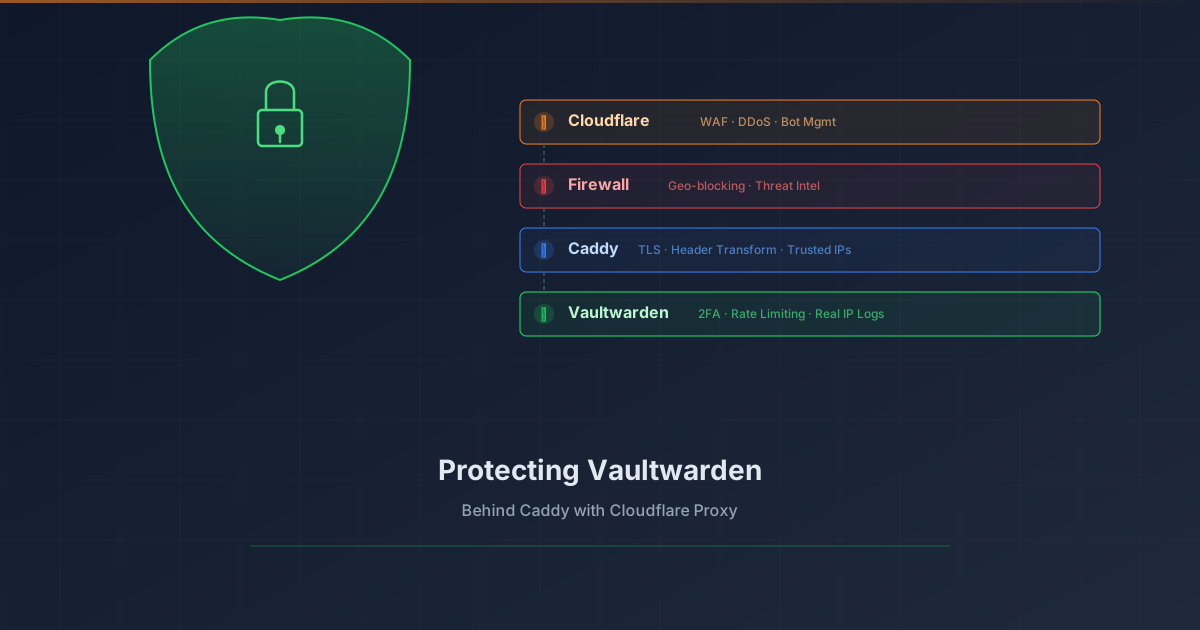
Overview # Your password vault is arguably the most sensitive service in your homelab. Exposing Vaultwarden to the internet requires layered protection. This tutorial shows how to add Cloudflare Proxy (WAF, DDoS protection, bot management) in front of Vaultwarden while preserving real client IP logging.
What you’ll achieve:
1 2 3 4 5 6 7 8 9 Client (real IP) ↓ Cloudflare Edge (WAF, DDoS, Bot protection) ↓ CF-Connecting-IP header Your Firewall (geo-blocking, threat intel) ↓ Caddy (extracts real IP, TLS termination) ↓ X-Real-IP header Vaultwarden (rate limiting, 2FA, logs real IP) Prerequisites # Vaultwarden already running behind Caddy reverse proxy Domain managed by Cloudflare (DNS) Caddy with valid TLS certificates (Let’s Encrypt/ACME) Basic understanding of reverse proxies The Problem # When you enable Cloudflare Proxy (orange cloud), traffic flows through Cloudflare’s edge servers before reaching your origin. This provides excellent protection, but introduces two challenges:
Overview # I migrated my internet speed monitoring from Speedtest Tracker to MySpeed after learning that Speedtest Tracker was deprecating native Discord notifications. Rather than adding an Apprise sidecar container for notifications, I opted for MySpeed which has built-in Discord support.
Why Migrate? # Factor Speedtest Tracker MySpeed Stack Laravel/PHP Node.js Discord Deprecated (needs Apprise) Native support Complexity nginx + php-fpm + SQLite Single Docker container Updates Manual WUD opt-in monitoring Architecture Comparison #
Overview # This site uses a hybrid content structure that combines the best of wikis and blogs. Instead of choosing between “everything chronological” or “everything by topic,” we get both:
Wiki sections for evergreen reference content (organized by topic) Blog posts for journey updates and lessons learned (organized by date) Tutorials for step-by-step guides (standalone, searchable) Series for multi-part deep dives (linked learning paths) Content Architecture #