
The Goal#
Turn Claude Code from a stateless coding assistant into a persistent personal assistant — a second brain that remembers context across sessions, learns from daily work, and can semantically search past knowledge.
Inspired by Hermes’s personalization architecture, adapted for Claude Code’s native capabilities.
Hermes’s Approach (The Model)#
Hermes creates personalization through:
| Feature | How It Works |
|---|---|
| Two-layer memory | MEMORY.md (curated long-term) + memory/YYYY-MM-DD.md (daily logs) |
| Auto memory flush | Before context compaction, agent writes insights to disk |
| Hybrid search | Vector embeddings + keyword search over all memory files |
| Skills system | Markdown files as on-demand knowledge that grow over time |
| Centralized preferences | Single file for personal prefs |
| External integrations | Obsidian vault, health data, communication channels |
Gap Analysis: Claude Code vs Hermes#
Claude Code already has ~70% of the infrastructure. The gap is automation glue, not features.
| Hermes Feature | Claude Code Status | Gap |
|---|---|---|
| Curated MEMORY.md | Exists (first 200 lines auto-loaded) | LOW - needs restructuring |
| Daily logs | Missing entirely | HIGH |
| Pre-compaction flush | Hook system exists, not configured | HIGH |
| Vector/semantic search | No MCP server for this | HIGH |
| Centralized preferences | Split across 3+ config files | MEDIUM |
| Skills that learn | Skills exist but static | MEDIUM |
| Notepad wisdom | Infrastructure exists, unused | LOW |
Architecture#
| |
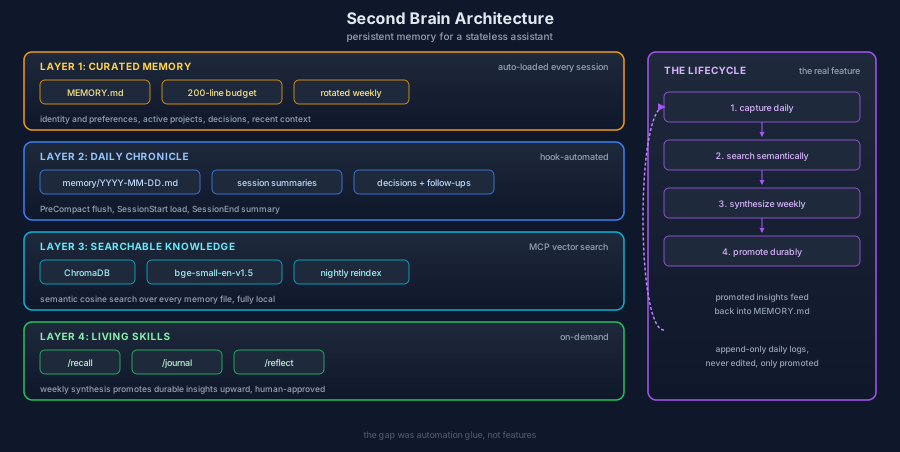
Implementation Plan#
Phase 1: Quick Wins (1-2 hours)#
- Restructure MEMORY.md — Curated 200-line template with sections: Identity, Active Projects, Preferences, Architectural Decisions, Patterns Learned, Recent Context
- Create PREFERENCES.md — Centralized personal preferences (communication style, tech choices, work habits)
- Create daily log system —
~/.claude/memory/directory with.template.md - Create PreCompact hook —
memory-flush.shwrites context to daily log before compaction - Create SessionStart hook —
session-start-memory.shloads today’s log + yesterday’s follow-ups - Create SessionEnd hook —
session-summary.shappends session boundary to daily log - Configure hooks — Merge into
settings.local.json - Activate OMC notepad — Add reminder to use
addLearning(),addDecision()during planning
Phase 2: Enhanced Memory (3-4 hours)#
- Weekly reflection script —
weekly-reflect.shsynthesizes 7 days, flags promotion candidates (cron Sunday 9pm) - Memory cleanup script —
memory-cleanup.sharchives logs >30 days as .gz (cron monthly) - Create
/recallskill — Search across all memory files (daily logs, weekly syntheses, project memories) - Create
/journalskill — Structured daily entry creation with type classification - Create
/reflectskill — Weekly review and promotion to MEMORY.md (keeps under 200 lines) - Set up cron jobs — Weekly reflection + monthly cleanup + nightly reindex
Phase 3: Vector Search Brain (4-6 hours)#
- Build ChromaDB MCP server — Python MCP service with bge-small-en-v1.5 embeddings for semantic search
- Register MCP server — Added to
~/GIT/.mcp.json(workspace-level) - Set up nightly reindex — Cron job at 11pm Pacific to keep vectors fresh
- Optional: Obsidian bridge — Add vault path to indexer for personal notes
Approach Comparison#
| Dimension | Pure Native | Plugin-Enhanced | Full Hybrid (Chosen) |
|---|---|---|---|
| Complexity | Low | Medium | Medium-High |
| Token cost/session | Low | Medium | Low-Medium (on-demand) |
| Search quality | grep only | Varies | Keyword + semantic |
| Privacy | 100% local | Some phone home | 100% local |
| Scales to 1000+ logs | No | Depends | Yes |
| Offline capable | Yes | Maybe not | Yes |
Why Full Hybrid?#
- Phase 1 is zero-risk — hooks + markdown that make every session smarter, starting immediately
- Phase 2 makes it self-sustaining — weekly synthesis prevents memory rot
- Phase 3 is the real unlock — within 3 months there will be 90+ daily logs; without semantic search, old memories become unfindable
Plugins (Claude-Mem, Supermemory) are designed for users without sophisticated setups. They would conflict with the existing oh-my-claudecode orchestration layer and some require cloud APIs.
Key Design Decisions#
- ChromaDB over sqlite-vec/Qdrant/Pinecone — Industry default for local AI apps (25K GitHub stars, used by Claude-Mem plugin). Built-in HNSW index, PersistentClient for on-disk storage, cosine distance. sqlite-vec is lighter but less community support and tooling.
- bge-small-en-v1.5 over all-MiniLM-L6-v2 — Same 384 dimensions but 62% MTEB score vs 28%. Released 2023 vs 2019. Drop-in replacement with dramatically better retrieval quality.
- 200-line MEMORY.md budget — Claude Code auto-loads first 200 lines; every line must earn its place
- Daily logs are append-only — Never edit past entries, only promote insights upward
- Weekly reflection is manual — Script generates candidates, human approves promotions
Lessons Learned#
- Hermes’s power isn’t any single feature — it’s the lifecycle: capture daily, search semantically, synthesize weekly, promote durably
- Claude Code already has 70% of the infrastructure; the gap is automation glue
- The 200-line MEMORY.md limit is actually a feature — forces curation over accumulation
- Hooks (PreCompact, SessionStart, SessionEnd) are the critical integration points — note:
SessionStopis not a valid hook event, useSessionEnd - Local-first vector search (ChromaDB + bge-small-en-v1.5) beats cloud solutions for privacy and reliability
- Embedding model choice matters: bge-small-en-v1.5 (2023, 62% MTEB) dramatically outperforms all-MiniLM-L6-v2 (2019, 28% MTEB) at the same 384 dimensions