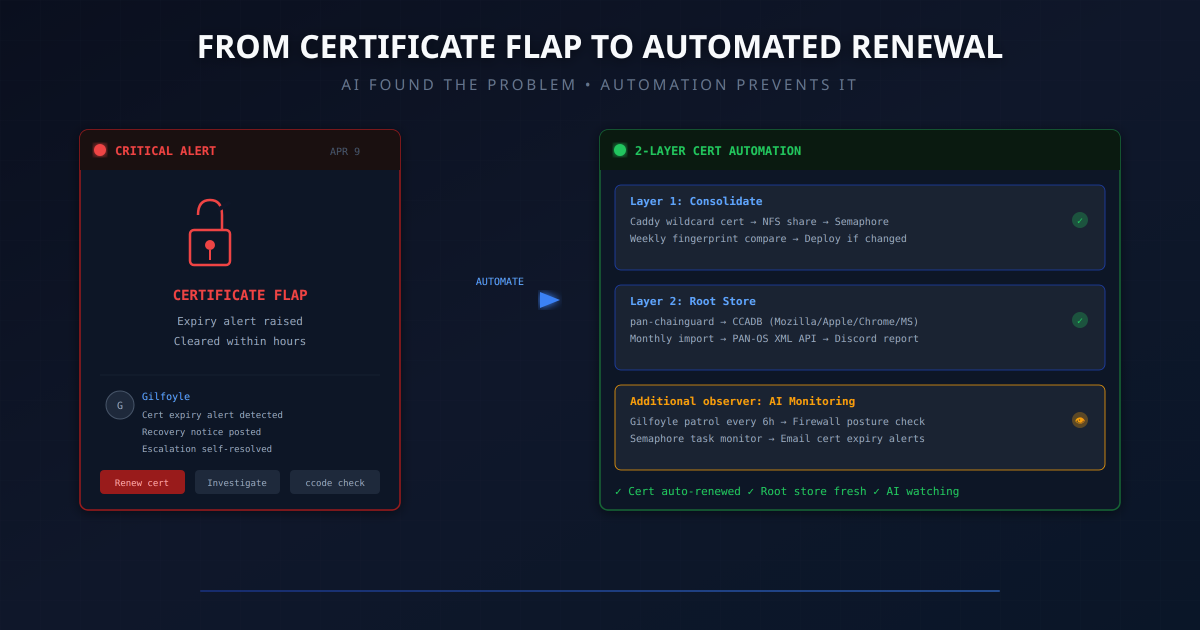
Update, October 14, 2026. This is the April certificate incident and the automation design that followed it. The monitoring schedules below describe that original setup, not a fresh verification of today’s jobs. Gilfoyle now has a Level 4 policy for bounded repairs, but the unattended controller remains inactive. A fresh Discord-route session loaded the new policy; warm sessions retained older prompts. The next chapter explains the rollout. It does not make certificate renewal an AI task.
The Wake-Up Call#
On April 9, Gilfoyle (my AI network admin) posted this at midnight:
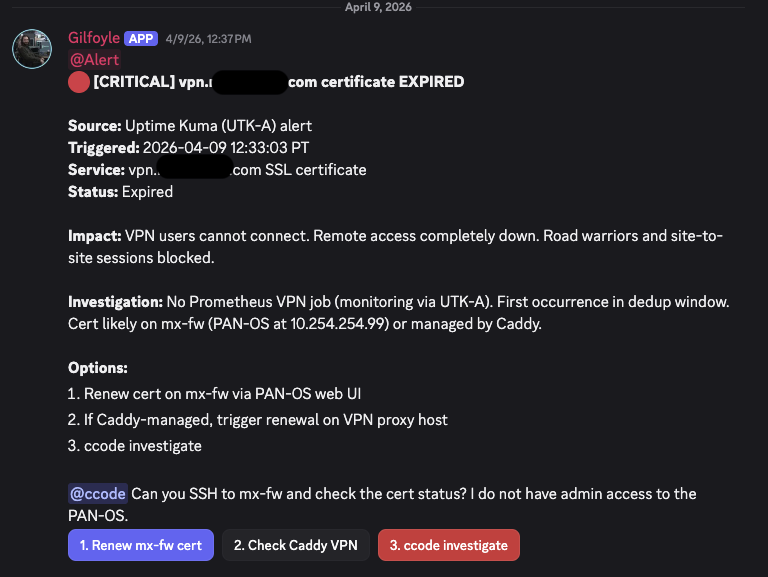
The cert flap resolved itself within hours. Gilfoyle posted the recovery notice, and ccode closed the escalation. No lasting impact.
But the question stuck with me: why was I relying on luck?
If that flap had lasted longer, during a weekend, during travel, during an incident that needed VPN access, I’d have been locked out of my own infrastructure. The AI caught it. But catching a fire isn’t the same as preventing one.
The Problem I Was Actually Solving#
My VPN certificate management was a mess:
→ Caddy already auto-renews *.<YOUR_DOMAIN> via Let’s Encrypt (Cloudflare DNS-01 challenge)
→ PAN-OS needs that same wildcard cert for the GlobalProtect VPN portal
→ A dedicated certificate LXC was running acme.sh separately, doing the exact same job Caddy already does
→ No monitoring on any of it, until Gilfoyle started watching
Two ACME clients renewing the same wildcard cert. An entire VM that existed solely to shuffle a certificate from point A to point B. And zero visibility into whether any of it was actually working.
The Architecture: Two Layers of Cert Automation#
I didn’t build this all at once. Each piece was a response to a real problem. The AI incident just connected them into a coherent system.
Layer 1: Consolidate Certificate Renewal#
Problem: Why run two separate ACME clients for the same wildcard cert?
Solution: Retire the dedicated certificate LXC. Reuse Caddy’s cert.
Caddy already auto-renews *.<YOUR_DOMAIN> and stores the cert/key on an NFS share (HA NFS pair). Proxmox mounts that share. A Semaphore Ansible playbook runs weekly, compares the Caddy cert fingerprint against what’s on the firewall, and only deploys when they differ.
| |
One ACME client. One renewal schedule. One less VM to maintain.
Layer 2: The AI Monitoring Loop#
Problem: The automation runs, but who watches the watcher?
Solution: Gilfoyle.
This is where the MCP server and the AI sysadmin tied together. In the April setup, Gilfoyle’s infrastructure patrol checked every 6 hours:
- Firewall posture via
fw_status(), including interface health, HA state, session count - Certificate expiry, caught by email-monitor (the firewall sends alerts when certs approach expiry)
- Semaphore failures, flagging if the weekly cert deploy playbook failed
When Gilfoyle sees a cert-related alert, the alert-correlator kicks in:
- Classify severity (Warning: expiring soon. Critical: expired.)
- Cross-reference: Is Semaphore’s cert deploy schedule running? When did it last succeed?
- Check: Is the firewall serving the right cert? (via the MCP’s
fw_statustool) - Report with options and wait for approval
The AI doesn’t renew certs. It watches the automation that renews certs and tells me when something breaks.
PAN-OS XML API: What Nobody Tells You#
A few gotchas I hit that aren’t in the documentation:
Private key import requires passphrase=none even for unencrypted PEM keys. Without this parameter, the API silently accepts the import but the key isn’t usable. The error only surfaces when you try to use the certificate.
Certificate chain import splits silently. Upload a PEM with server cert + intermediate, and PAN-OS imports only the leaf. You need to separately extract and import the intermediate CA:
| |
No show certificate in the XML API. I expected to verify imports by querying cert details. <show><certificate> returns “unexpected command.” Instead, poll the live endpoint with openssl s_client and compare fingerprints.
Partial commits scope by admin user. Using a dedicated certbot admin user with only certificate management permissions means cert deploys never interfere with other admin sessions.
What the Full Picture Looks Like#
| |
Why I Used AI For This#
I want to be clear about what the AI actually did here:
- Gilfoyle caught the expired cert. The monitoring that surfaced the problem.
- Claude Code (ccode) investigated. SSH’d into the firewall, checked cert state, confirmed the flap.
- I designed the automation. The Ansible playbooks, the Semaphore schedules, the NFS consolidation.
- Claude Code helped me build it. Wrote the playbook, debugged the XML API quirks, tested the deployment.
- Gilfoyle watched it. The April monitoring loop checked that the automation kept running.
The AI didn’t replace my thinking. It accelerated it. The expired cert was the signal. The AI helped me trace it to the root cause (fragmented cert management) and build the fix (consolidated automation with monitoring).
That’s the pattern I keep coming back to: AI surfaces the problem, AI helps you build the solution, AI watches the solution run. You make the decisions.
Lessons Learned#
1. Catching a fire isn’t preventing one#
Gilfoyle flagged the expired cert. Great. But if I’d stopped there, I’d just have a better alarm system. The real value was using the incident to build automation that eliminates the failure mode entirely.
2. Consolidate before you automate#
I could have automated the dedicated certificate LXC’s acme.sh setup. Instead, I retired it and reused Caddy’s cert. One less moving part. The best automation is the kind you don’t need to build because you eliminated the complexity.
3. The AI monitoring loop closes the gap#
Automation handles the happy path. Monitoring handles the exceptions. The April design aimed to catch failures at the next six-hour patrol, rather than at certificate expiry. That was the monitoring target, not a guarantee that every failure would be detected on schedule.
4. PAN-OS XML API demands patience#
The silent failures (key import without passphrase, chain splitting, missing show commands) would have cost me days without AI assistance. Claude Code’s ability to iterate rapidly on API quirks, try, fail, read error, adjust, compressed what would have been a weekend of documentation-hunting into an afternoon.
5. Document the gotchas for your future AI#
The PAN-OS API quirks are now in a CLAUDE.md file in the project directory. When I (or an AI) touch this automation next year, the context is there. The AI that helped me build it is also the system that will help me maintain it.