Why an XDR in a Homelab? # When I first started building out my homelab infrastructure, I fell into the same trap that catches most homelab enthusiasts: I assumed that being behind a firewall made me safe. After all, I wasn’t running a Fortune 500 network. I had VLANs, I had a next-generation firewall doing deep packet inspection, and I kept my systems patched. What more did I need?
The Problem # Watchtower had been my go-to for automatic Docker container updates across 8+ services. It worked… mostly. But I kept running into issues:
Opt-out model is dangerous - Watchtower watches ALL containers by default. I had to remember to add com.centurylinklabs.watchtower.enable=false to containers I didn’t want updated. Forgetting meant surprise updates.
No visibility - Updates happened silently at 4 AM. I only knew something updated when it broke. No dashboard, no easy way to see pending updates.
The Challenge # I needed a unified security monitoring solution that could:
Provide endpoint detection and response (XDR) capabilities Integrate with my existing Graylog centralized logging infrastructure Scale from a single-node deployment to multi-node if needed Work with my existing OpenClaw threat intelligence feeds The Solution # Wazuh Single-Node Stack # Deployed Wazuh as a Docker-based single-node stack. The single-node architecture includes:
The Challenge # I watched a YouTube video titled “I Stopped Using PowerPoint Once I Learned This Claude Method” that demonstrated creating presentations using HTML instead of PowerPoint. The approach was compelling: single HTML files that run in browsers, support full CSS animations, and can be deployed to GitHub Pages for instant sharing.
But here’s the thing - I already had a pptx skill installed that generates actual PowerPoint files. Should I replace it? Enhance it? Or build something new?
The Problem # I noticed my Graylog VM was consuming more memory than expected. The VM has 4GB RAM allocated, but both Graylog and OpenSearch were competing for memory, leaving little headroom for the operating system’s filesystem cache.
What I Tried # First, I checked memory usage on the Graylog VM:
Overview # I migrated my internet speed monitoring from Speedtest Tracker to MySpeed after learning that Speedtest Tracker was deprecating native Discord notifications. Rather than adding an Apprise sidecar container for notifications, I opted for MySpeed which has built-in Discord support.
Why Migrate? # Factor Speedtest Tracker MySpeed Stack Laravel/PHP Node.js Discord Deprecated (needs Apprise) Native support Complexity nginx + php-fpm + SQLite Single Docker container Updates Manual WUD opt-in monitoring Architecture Comparison #
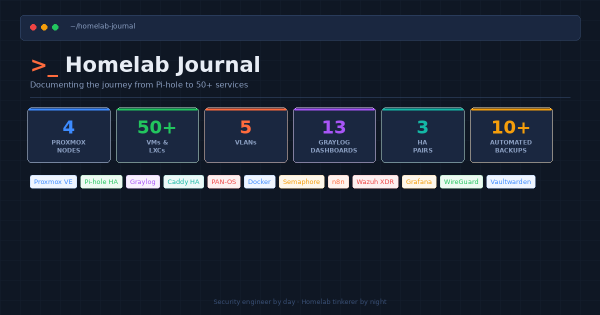
The Beginning # Every homelab starts somewhere. Mine started with a Raspberry Pi running Pi-hole because I was tired of ads on my smart TV. That was three years ago.
Today, I’m running a 4-node Proxmox cluster with 50+ containers, enterprise-grade networking, centralized logging, and more automation than I probably need. Somewhere along the way, I realized I should write this down.