AI-augmented homelab operations, from multi-agent orchestration to automated content pipelines. This wiki documents how Claude Code and agentic patterns accelerate infrastructure work.
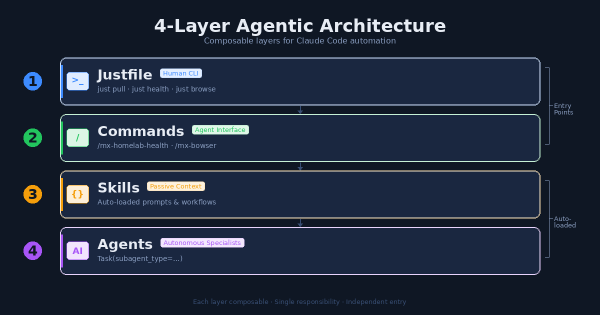
4-Layer Agentic Architecture # A framework for organizing AI-assisted automation into composable layers:
Building a 4-Layer Agentic Architecture for Claude Code: Justfile, Commands, Skills, and Agents, where each layer has a single responsibility Skill Development # The Skills layer outgrew a folder of one-off scripts. It is now a curated collection of 60+ skills with a shared prefix: journaling, homelab health checks, code mentoring, adversarial review, and build-plan generation. Skills live in a central configuration repo and deploy to every machine via symlink, so a skill written on the laptop shows up in the homelab session an hour later.
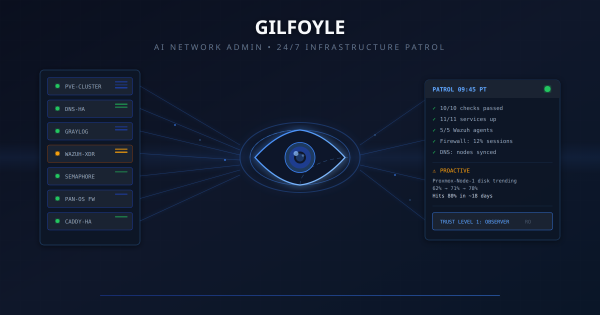
Update, October 14, 2026. The patrols, capabilities, and trust ladder below describe Gilfoyle’s April rollout. A Level 4 policy now defines bounded authority for single-service repairs with a known rollback and fault-specific checks. The unattended controller remains inactive. Verification showed that a fresh session on the Discord route loaded the October 14 policy; already-warm sessions can retain their older prompts. The next chapter explains what changed and what still needs verification.
Correction, September 2026. This post originally described the server as wrapping 9 services with 32 tools, including a confirmation-gated write surface and plans for an SSE transport. The maintained server is simpler and stricter than that: local stdio plus a CLI, up to 25 read-only tools across 10 configured backends, and 15 documentation resources. There are no write tools and no remote transport. Lifecycle changes (provisioning, DNS records, container updates) are owned by Semaphore automation, and the IPAM backend is now Nautobot — NetBox is retained rollback-only. The sections below have been rewritten to describe the current architecture; the original narrative is preserved where it explains the design decisions that still hold.
The Problem # After months of building Claude Code extensions (agents, skills, commands, hooks, MCP servers) I had a growing collection of powerful tools with no coherent entry point. Want to pull all repos? Run a shell script. Want to check infrastructure health? Ask Claude and hope it knows which command to use. Want to automate a browser task? Figure out whether to use the MCP plugin or write a script.
The Goal # Turn Claude Code from a stateless coding assistant into a persistent personal assistant — a second brain that remembers context across sessions, learns from daily work, and can semantically search past knowledge.
Inspired by Hermes’s personalization architecture, adapted for Claude Code’s native capabilities.
Hermes’s Approach (The Model) # Hermes creates personalization through: