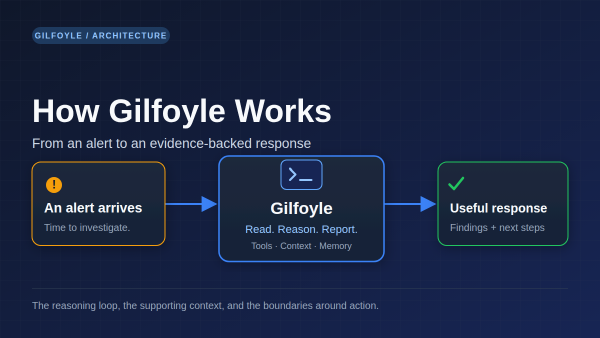
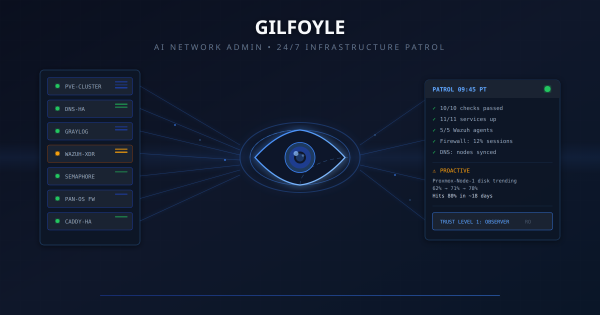
An infrastructure alert lands in Discord. Turning it into a useful response takes more than adding an LLM: something has to decide whether the message belongs in the queue, collect evidence, preserve the incident context, and know when to stop.
That is the machinery around Gilfoyle. The original introduction covered the April rollout. This is the current system, checked on October 15: how a signal reaches him, how he investigates, and which parts run without asking a model anything.
Update, October 14, 2026. The patrols, capabilities, and trust ladder below describe Gilfoyle’s April rollout. A Level 4 policy now defines bounded authority for single-service repairs with a known rollback and fault-specific checks. The unattended controller remains inactive. Verification showed that a fresh session on the Discord route loaded the October 14 policy; already-warm sessions can retain their older prompts. The next chapter explains what changed and what still needs verification.
The Goal # Add all 4 Proxmox VE cluster nodes (pve-mini2, pve-mini3, pve-mini5, pve-mini6) to the existing Prometheus/Grafana stack on LXC 30194. The monitoring stack already covered Graylog, Windows desktop, and PAN-OS firewall metrics – Proxmox was the last major gap.
Approach: pve-exporter vs node_exporter # I evaluated two options:
Visibility into 50+ services requires centralized logging, proactive alerting, and dashboards. This wiki covers my monitoring stack and the patterns that make it work.
Monitoring Stack # Graylog Centralized Logging # Graylog is my log aggregation platform—collecting, processing, and visualizing logs from across the homelab.
Why an XDR in a Homelab? # When I first started building out my homelab infrastructure, I fell into the same trap that catches most homelab enthusiasts: I assumed that being behind a firewall made me safe. After all, I wasn’t running a Fortune 500 network. I had VLANs, I had a next-generation firewall doing deep packet inspection, and I kept my systems patched. What more did I need?
The Challenge # I needed a unified security monitoring solution that could:
Provide endpoint detection and response (XDR) capabilities Integrate with my existing Graylog centralized logging infrastructure Scale from a single-node deployment to multi-node if needed Work with my existing Hermes threat intelligence feeds The Solution # Wazuh Single-Node Stack # Deployed Wazuh as a Docker-based single-node stack. The single-node architecture includes: