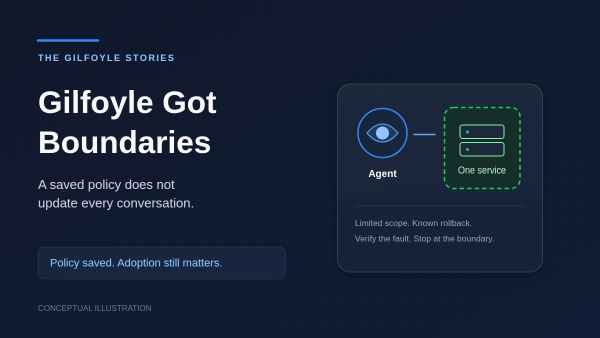
Changing my AI admin’s rules should have been straightforward: save the policy, deploy it, restart the gateway. Then I traced how an existing conversation restores its instructions: it can reuse its stored prompt instead of loading the new policy file. Apparently Gilfoyle had a way to keep outdated management instructions. Very on brand.
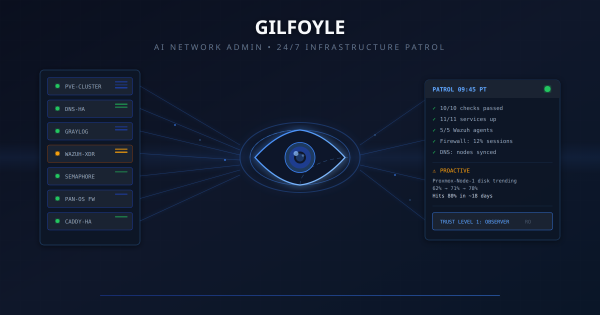
When I introduced Gilfoyle in April, he was an observer. He watched services, investigated alerts, and told me what broke. By October, his policy carried an Admin label. The interesting work became deciding exactly what that label allowed, then checking which conversations actually loaded those rules.
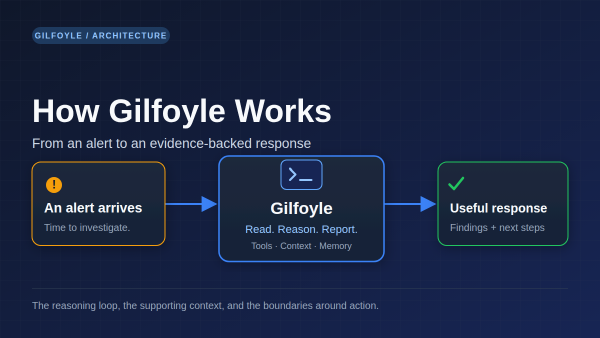
An infrastructure alert lands in Discord. Turning it into a useful response takes more than adding an LLM: something has to decide whether the message belongs in the queue, collect evidence, preserve the incident context, and know when to stop.
That is the machinery around Gilfoyle. The original introduction covered the April rollout. This is the current system, checked on October 15: how a signal reaches him, how he investigates, and which parts run without asking a model anything.
Most organizations can tell you whether their firewalls are healthy. Fewer can prove every allow rule is inspected, logged, owned, and still required.
The gap between those two things is where audits become painful. Multiple firewall admins, emergency changes at 2am, quarterly reviews that turn into archaeology digs, vendor access rules that were “temporary” in February and are still there in October. Nobody disabled them because nobody noticed they were still there. No alert fires when a rule that was supposed to be temporary quietly becomes permanent.
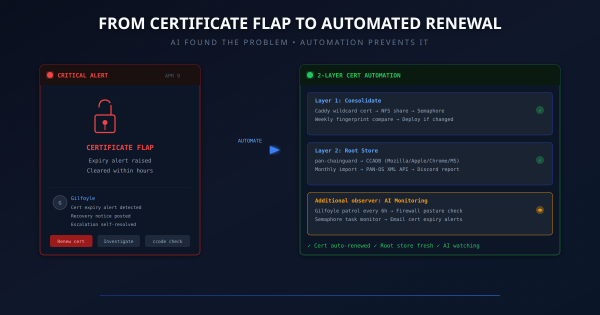
Update, October 14, 2026. This is the April certificate incident and the automation design that followed it. The monitoring schedules below describe that original setup, not a fresh verification of today’s jobs. Gilfoyle now has a Level 4 policy for bounded repairs, but the unattended controller remains inactive. A fresh Discord-route session loaded the new policy; warm sessions retained older prompts. The next chapter explains the rollout. It does not make certificate renewal an AI task.
Update, October 14, 2026. The patrols, capabilities, and trust ladder below describe Gilfoyle’s April rollout. A Level 4 policy now defines bounded authority for single-service repairs with a known rollback and fault-specific checks. The unattended controller remains inactive. Verification showed that a fresh session on the Discord route loaded the October 14 policy; already-warm sessions can retain their older prompts. The next chapter explains what changed and what still needs verification.
The Problem # My PAN-OS firewall (GlobalProtect VPN portal at vpn.mareoxlan.com) needs a valid TLS certificate. I had a dedicated LXC (30122) running acme.sh with a Cloudflare DNS-01 challenge to issue a wildcard cert, then a PAN-OS deploy hook to push it to the firewall via the XML API. It worked, but it was a single-purpose VM doing the same job my Caddy reverse proxy already does – Caddy auto-renews *.mareoxlan.com via the same Cloudflare DNS-01 mechanism.
Why an XDR in a Homelab? # When I first started building out my homelab infrastructure, I fell into the same trap that catches most homelab enthusiasts: I assumed that being behind a firewall made me safe. After all, I wasn’t running a Fortune 500 network. I had VLANs, I had a next-generation firewall doing deep packet inspection, and I kept my systems patched. What more did I need?
The Challenge # I needed a unified security monitoring solution that could:
Provide endpoint detection and response (XDR) capabilities Integrate with my existing Graylog centralized logging infrastructure Scale from a single-node deployment to multi-node if needed Work with my existing Hermes threat intelligence feeds The Solution # Wazuh Single-Node Stack # Deployed Wazuh as a Docker-based single-node stack. The single-node architecture includes:
Enterprise security principles applied to a homelab. This wiki covers the layered security architecture — from next-gen firewall policies to XDR threat detection to certificate lifecycle automation.
Firewall Architecture # The Palo Alto Networks PA-440 provides the network security foundation with App-ID, zone-based policies, and centralized logging. Full details in the Networking wiki — including security zones, VLAN trust levels, and DNS proxy configuration.