Overview#
After multiple outages caused by configuration drift between two HA Caddy reverse proxy nodes, I built a GitOps pipeline that automatically deploys configs to both nodes whenever changes are pushed to the main branch. Config drift is now impossible by design.
The problem: Two Caddy nodes in a keepalived HA pair need identical configs. Forgetting to deploy to the second node after editing a site config caused service outages — twice in the same week.
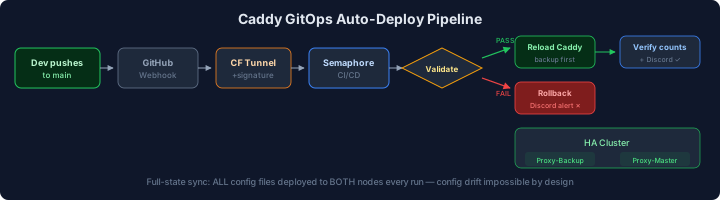
The solution: Push config changes to Git, and a webhook pipeline handles the rest — deploying to both nodes, validating, rolling back on failure, and notifying Discord.
Diagram#
Components#
GitHub Webhook#
- Fires on every push to
main - Sends payload with commit SHA and ref
- Uses HMAC-SHA256 signature for authentication
- Delivers through Cloudflare Tunnel (no port forwarding needed)
Semaphore Integration#
- Validates webhook signature (prevents unauthorized triggers)
- Matches only
refs/heads/main(ignores other branches) - Extracts
commit_shafrom payload for audit trail - Triggers the Ansible template automatically
Ansible Playbook (sync-caddy-sites.yml)#
An 8-phase playbook that handles the full deployment lifecycle:
- Pre-flight: Verify SSH access to both nodes, check file integrity (truncation guard rejects files < 100 bytes)
- Backup: Timestamped backup of current configs on each node
- Deploy: SCP all site files, snippets, and main Caddyfile to both nodes
- Validate: Run
caddy validateinside the container on both nodes - Rollback (on failure): Restore from backup, notify Discord, fail the task
- Reload: Graceful reload — backup node first, then master (minimizes HA disruption)
- Verify: Count deployed domains vs Git repo — detects drift immediately
- Cleanup: Prune old backups (keep last 5 per node)
Discord Notifications#
- Success: Green embed with commit hash, domain count, files synced
- Failure: Red embed with failed nodes and rollback confirmation
- Dry Run: Yellow embed (validation only, no reload)
Design Decisions#
Why Semaphore (not GitHub Actions)?#
Semaphore runs inside the homelab network, with direct SSH access to both Caddy nodes. GitHub Actions would need a self-hosted runner or VPN tunnel to reach internal servers. Semaphore also manages all other homelab automation (power management, maintenance, updates), keeping everything in one place.
Why sync ALL files every run (not just changed files)?#
Simpler and more reliable. Parsing GitHub’s changed-files list adds complexity and edge cases (renamed files, moved content). Syncing everything guarantees both nodes match Git — the whole point of eliminating drift. The full sync takes ~25 seconds for 4 site files + 1 snippet + Caddyfile.
Why reload backup node first?#
If the reload somehow breaks a node (despite validation passing), the backup node fails first while the master continues serving traffic. The keepalived VIP stays on the healthy master throughout.
Why Cloudflare Tunnel for the webhook?#
The Semaphore instance is behind NAT with no public IP. Cloudflare Tunnel provides a stable external endpoint (sema.<YOUR_DOMAIN>) that GitHub can reach, without opening firewall ports. The same tunnel already serves other homelab services.
Why a truncation guard?#
A previous outage was caused by deploying a truncated config file (incomplete SCP transfer). The playbook now rejects any site file smaller than 100 bytes — a legitimate Caddy config is never that small.
Trade-offs#
| Decision | Benefit | Cost |
|---|---|---|
| Full sync (not diff-based) | Zero drift guarantee | ~25s per run even for tiny changes |
| Webhook on all pushes to main | Simple setup | Triggers on non-Caddy changes too (playbook handles gracefully) |
| Rollback on ANY validation failure | Protects both nodes | Could rollback one node unnecessarily if only the other has issues |
| No approval gate | Instant deploys | Bad config deploys immediately (mitigated by validation + rollback) |
What I Learned#
Ansible self-referencing variables are a trap. Defining dry_run: "{{ dry_run | default(false) }}" in a vars: block causes an infinite template recursion when the variable isn’t passed. The fix: remove the definition entirely and inline | default(false) at every usage point. I hit this twice in the same playbook (first commit_sha, then dry_run).
Semaphore webhook endpoints use random aliases, not numeric IDs. The integration API creates an integration with a numeric ID, but the webhook receiver endpoint requires a separate alias object (/api/integrations/<random_string>). Without creating the alias, webhook deliveries return “no rows in result set.”
Cloudflare Tunnel public hostnames vs DNS records are different things. Adding a regular DNS A record for a service behind a tunnel doesn’t work — it resolves to your WAN IP, which has no port forwarding. The service must be added as a “Public Hostname” in the Cloudflare Zero Trust tunnel configuration, which routes through the tunnel’s encrypted connection.
Results#
- Before: Manual SCP to two nodes, prone to forgetting one. Multiple outages from config drift.
- After: Push to Git, both nodes update in ~25 seconds with validation and rollback safety.
- Pipeline verified: Two consecutive successful runs deploying real config changes through the full webhook chain.